
What's going on, my ASVAB party people! It's Coach Anderson. I've got a surprise for you, and it's a big one. We now have a course for ASVAB Mechanical Comprehension, and the first unit, Pulleys, is live right now as a beta.
Outside of the four AFQT subjects, Mechanical Comprehension is the one that shows up the most in the line scores that decide your job. So if the job you want is technical, this is not a subtest to guess your way through. On this page I'll show you what the subtest is, teach you one idea you can watch with your own eyes, and walk you through the course step by step. If you'd rather jump straight in, the course is right here.
What Is ASVAB Mechanical Comprehension?
Mechanical Comprehension, or MC, tests how well you understand physical things: what a machine does, where a force goes, and what holds weight. The official ASVAB site describes it as knowledge of mechanical and physical principles. The official outline names six areas:
- Simple machines: one device that trades force for distance, like a pulley or a lever.
- Compound machines: simple machines working together, like gears and belt drives.
- Mechanical motion: how things speed up, slow down and resist moving.
- Fluid dynamics: how liquids and gases push and flow.
- Structural support: what holds weight and what tips over.
- Properties of materials: how materials react to heat and load.
Here is how the subtest is timed on the computer version, the CAT-ASVAB, and on paper:
| Computer | Paper | |
|---|---|---|
| Questions | 15 | 25 |
| Time | 22 minutes | 19 minutes |
On the computer you may also get up to 15 tryout questions mixed in. They don't count toward your score, and you get 42 minutes when they're there.
The computer numbers are from the official CAT-ASVAB page. You can also try the official Mechanical Comprehension sample questions.
Two things about the questions themselves. First, almost every one is a picture and one short sentence with four choices. Second, there is very little arithmetic. In the official sample questions, only one out of eight asks you to calculate anything. This subtest rewards understanding, not memorizing.
Does it count toward your AFQT?
No. Your AFQT comes from the four main subjects: Arithmetic Reasoning, Math Knowledge, Word Knowledge and Paragraph Comprehension. Mechanical Comprehension counts in your line scores. It is part of the Marine Corps GT score, it is in the Mechanical line scores for the Marine Corps and the Air Force, it is in several Navy line scores, and it carries weight in the Army's line scores too. If you want to see how scores turn into jobs, read what jobs you qualify for with your ASVAB score.
Pulleys and Mechanical Advantage: Count the Ropes
Here's the thing about mechanical questions. You can read about a pulley all day, or you can watch one work for ten seconds. So let's watch. These are the same animations you'll see inside the lessons.
A pulley trades pull for rope. The more ropes holding the load, the less you have to pull. Pick a rig and watch what happens to the pull.
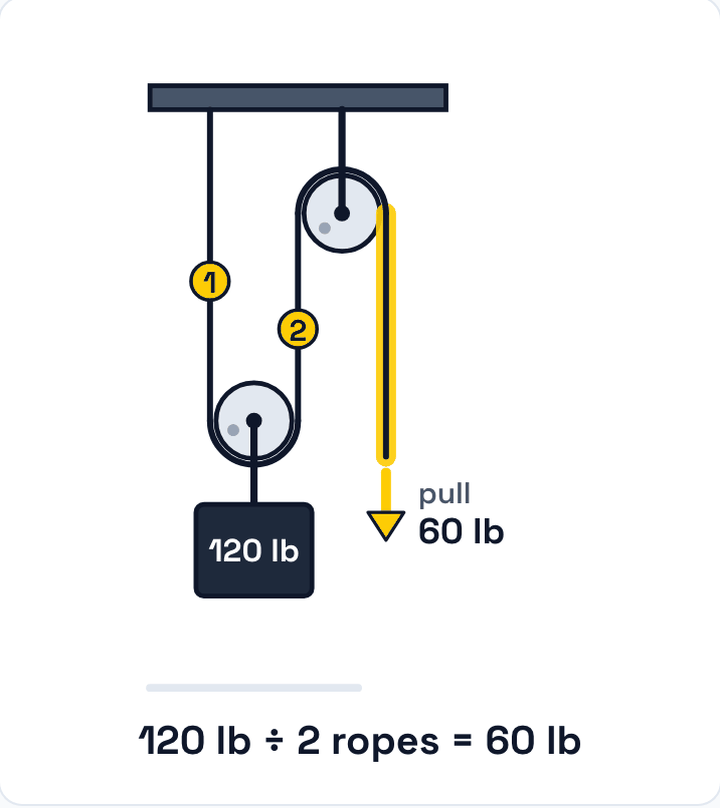
Pull = load ÷ the ropes holding it 2 ropes: 120 ÷ 2 = 60 lb. 4 ropes: 120 ÷ 4 = 30 lb.
That number of ropes has a name: mechanical advantage. The mechanical advantage of a pulley system is the number of ropes holding the load. Four ropes holding the load is a mechanical advantage of 4, so your pull is one fourth of the load. A rig with fixed and moving pulleys on one rope is called a block and tackle. Friction and the weight of the pulleys are left out here.
| Pulley rig | Mechanical advantage | Pull on 120 lb |
|---|---|---|
| One fixed pulley | 1 | 120 lb |
| One movable pulley, 2 ropes | 2 | 60 lb |
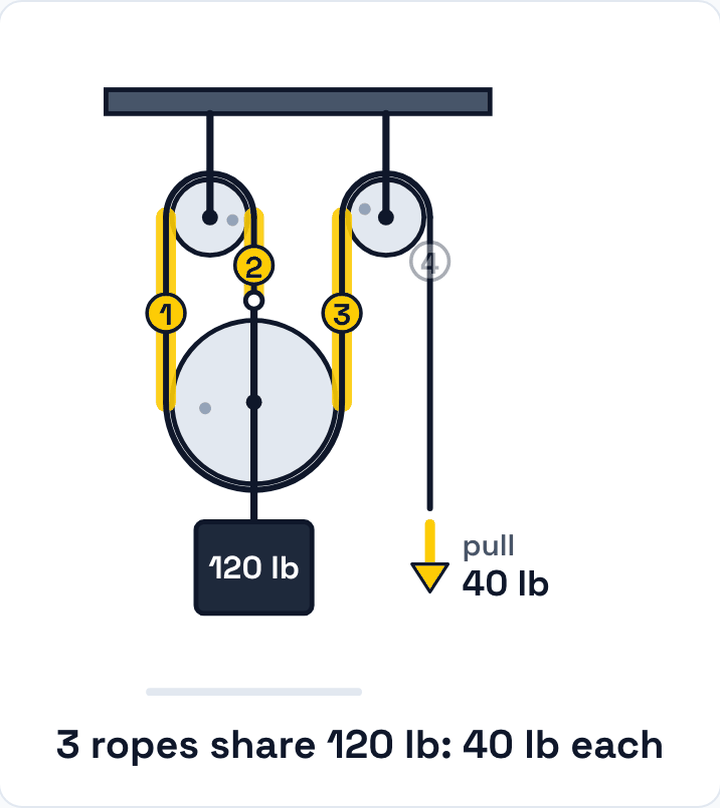
| Block and tackle, 3 ropes | 3 | 40 lb |
| Block and tackle, 4 ropes | 4 | 30 lb |
Which ropes count?
This is the part that trips people up. The rope in your hand only counts when you pull up. If it comes down off a fixed pulley, it is not holding the crate up. Watch which ropes light up.
Less pull costs more rope
Nothing is free. A rig that cuts your pull in half makes you pull twice as much rope. Every rope holding the load has to get shorter, and all of that rope comes out through your hands.
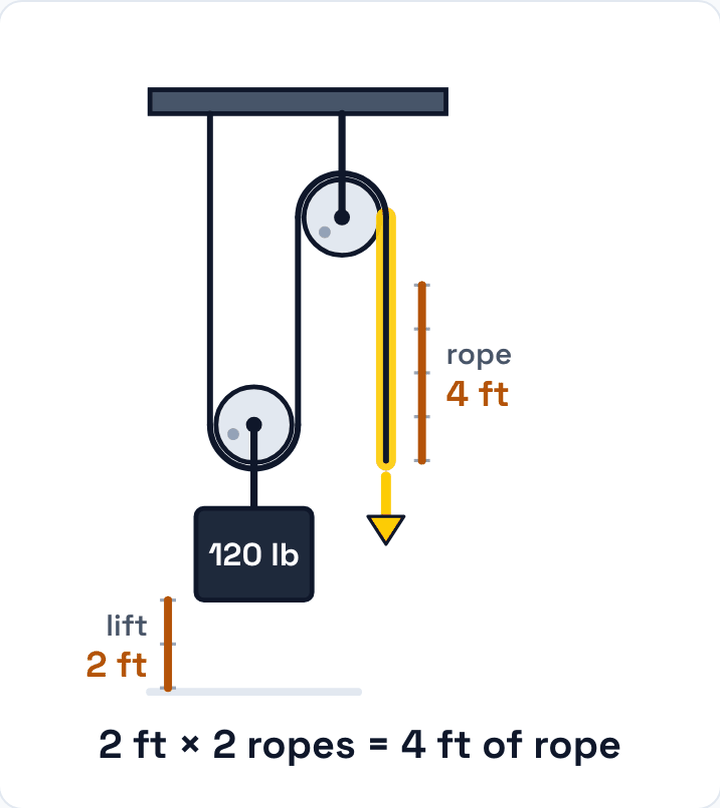
Rope pulled = lift × the ropes holding the load
What the beam holds
One more, and it surprises people. When you pull down on a fixed pulley, the beam is holding the crate and your pull at the same time.
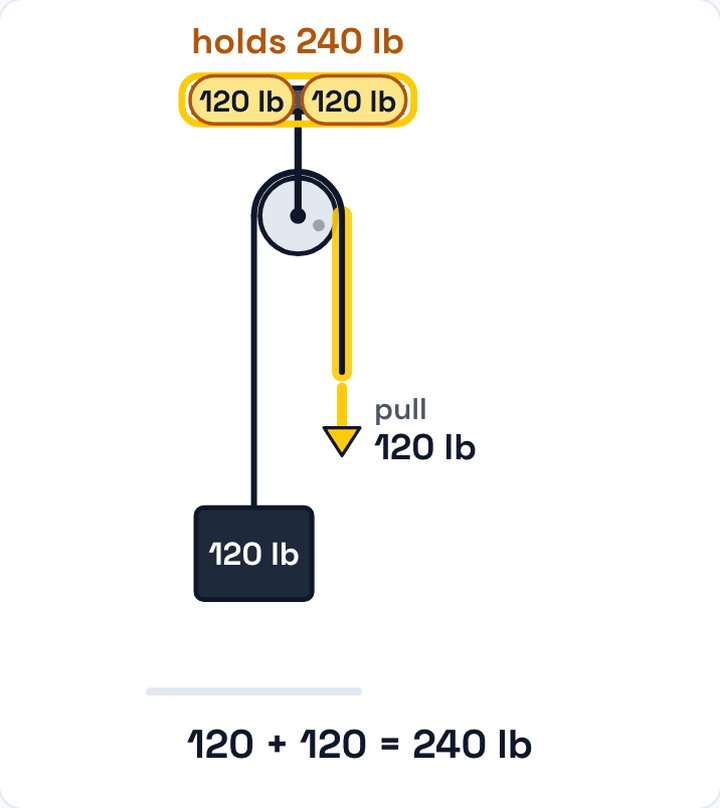
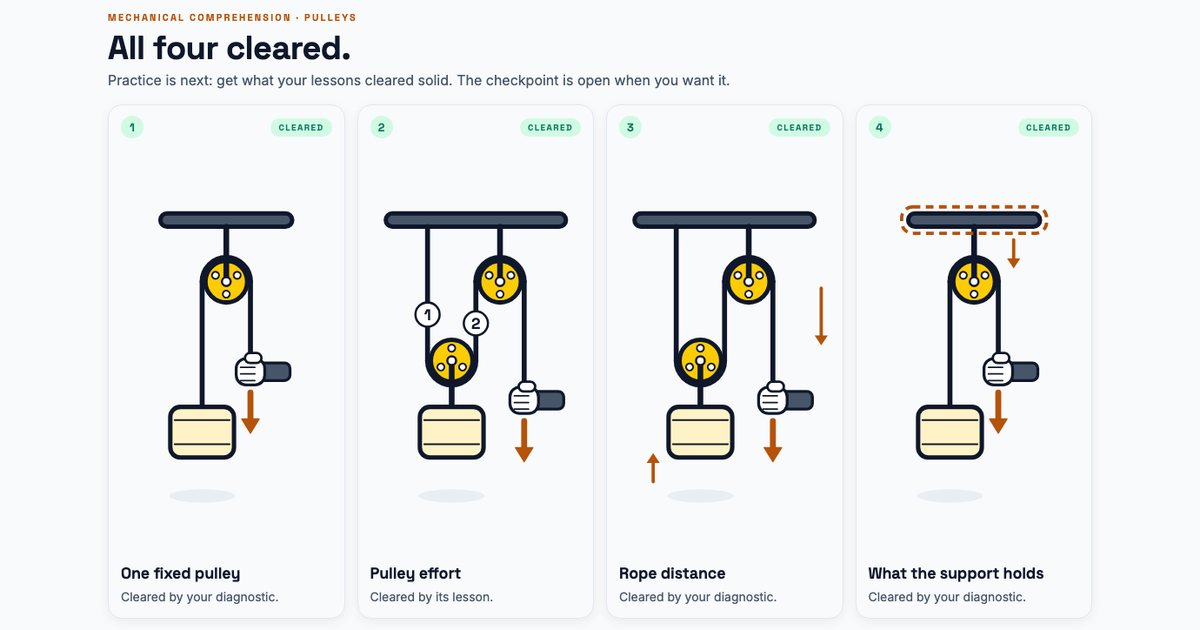
Those four ideas are the four lessons in the Pulleys unit: one fixed pulley, pulley effort, rope distance, and what the support holds.
How to Practice Mechanical Comprehension, Step by Step
The course works the same way on your phone and on a computer. Here is the order you'll move through it.
1Get in
Sign in and go to your dashboard. Mechanical Comprehension is the first card in your course list, tagged Beta. Don't have an account yet? It's free to make one. The button below walks you through it and brings you right back to the course.
2Start at the board
The board shows the four things you'll learn, in order, and one gold button with your next step. You never have to guess what to do next.

3Take the diagnostic
The diagnostic checks what you already know, three questions for each idea. Get all three right and that idea is cleared, so you skip its lesson. Miss one and the diagnostic moves on, and that lesson will be waiting for you. It takes between 4 and 12 questions. You see how you did at the end, not after each one.

When it ends you get a clear list of what you cleared and what you'll learn.

4Work the lessons
Each lesson has three parts: the fact, why it works, and Try it. The rig moves while you learn, so you see the numbers happen. Pick a wrong answer and the lesson tells you what went wrong with that exact choice. Work every question in Try it and the idea is cleared.

5Keep the study guide close
The study guide puts all four ideas on one page, with the pictures. Keep it open beside you while you practice, or print it.

6Practice until it's solid
Unit practice opens as soon as you clear one idea, and it never runs out. It starts at Level 1. Three right in a row moves you up a level, and two wrong in a row moves you down. Get an idea right three times in a row at its hardest level and it is marked Solid. There is no timer here, so take your time.
Every wrong choice comes with its own explanation, because that is where the learning happens. The questions are built fresh each time. The rig, the numbers and the order of the answers change, so you learn the idea instead of memorizing an answer.

7Take the checkpoint
The checkpoint unlocks when all four ideas are cleared. It is 15 questions in 22 minutes, the same count and clock as the computer version of the subtest. It climbs the way practice does, except one miss moves you down a level.

Your stars come from the hardest questions. Every Level 3 question you get right counts toward a star. One right earns your first star, and nine earns all five.
You can take the checkpoint again as many times as you want. When you finish a try, go to Review your answers. You'll see every question, the right answer, why it is right, and what each wrong choice gets wrong.


8Tell me what you think
This step matters the most to me. Feedback is in the top bar of the course. Tell me what you liked, what confused you, and what you want next. After your checkpoint you'll also get two quick questions about your favorite features and what to add. We read every note.

What Comes Next Is Up to You
Pulleys is one unit on purpose. I wanted to get one unit right, put it in your hands, and build the rest around what you tell me. Gears, levers, fluids and structures are all on the way, and your feedback shapes what gets built next and how.
The beta is free for everyone to try all November, and program members will get the full course for free when it's released.
It's because of the words you give and the feedback you give that we're always able to get better. So go in, try it, and tell me the truth about it.
Quick Answers About ASVAB Mechanical Comprehension
How many questions are on the Mechanical Comprehension subtest?
The computer version, the CAT-ASVAB, has 15 scored questions in 22 minutes. The paper version has 25 questions in 19 minutes.
What is on the ASVAB Mechanical Comprehension test?
Questions about simple machines, compound machines, mechanical motion, fluid dynamics, structural support and properties of materials. Think pulleys, levers, gears, friction, pressure and what holds weight.
How do you find the mechanical advantage of a pulley?
Count the ropes holding the load. One fixed pulley has a mechanical advantage of 1. A movable pulley with two ropes holding the load has a mechanical advantage of 2. Divide the load by that number to get your pull.
Are there ASVAB Mechanical Comprehension practice questions here?
Yes. The Pulleys unit has a diagnostic, practice questions that never run out, a study guide, and a timed checkpoint of 15 questions in 22 minutes. More units are on the way.
Is Mechanical Comprehension part of the AFQT?
No. The AFQT is Arithmetic Reasoning, Math Knowledge, Word Knowledge and Paragraph Comprehension. Mechanical Comprehension counts in line scores, which help decide the jobs you qualify for.
Is there a lot of math in Mechanical Comprehension?
Not much. Most questions ask you to read a picture and reason about it. When there is math, it is usually one step, like dividing a load by the number of ropes holding it.
What is the best way to study for it?
Learn the idea behind each machine, then practice with pictures until you can explain why an answer is right. It's not about memorizing questions and hoping they'll be on the test. It's about understanding the concept well enough to explain it.
Does the course work on a phone?
Yes. Every screen is built to fit your phone, and the lessons, the practice and the checkpoint all work there.
Remember, it's not about perfection. It's about getting one day better, one day at a time. Go try the Pulleys unit, tell me what you think, and let's get you that job you deserve.
Coach Anderson